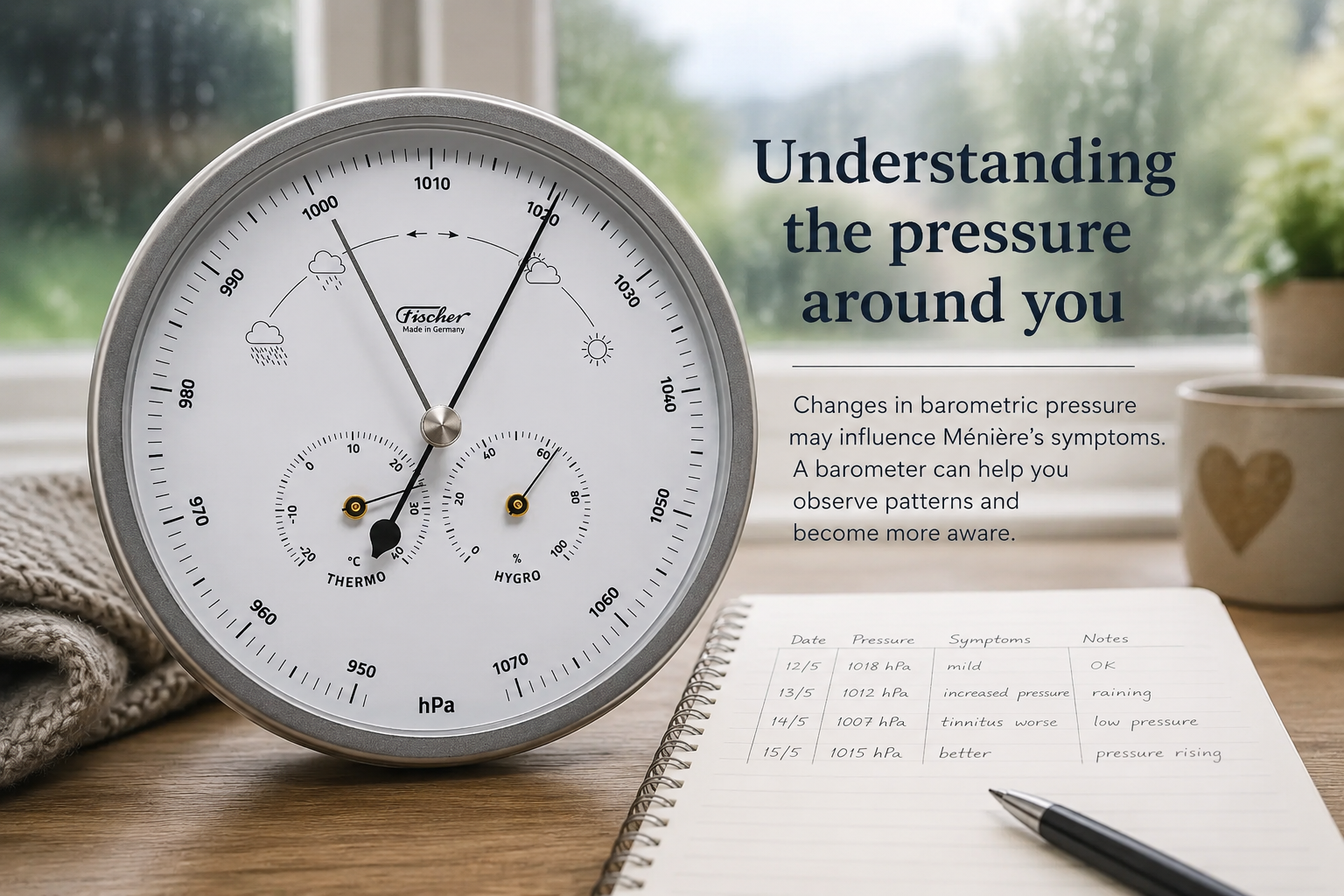

Have you ever noticed that your Ménière’s symptoms seem worse when the weather changes?
For some people living with Ménière’s disease, there may be more to that observation than coincidence.
My wife has Ménière’s disease, and over the years we have occasionally noticed that her ear can feel noticeably worse at certain times, particularly when the weather is changing. She has gradually become much more aware of the barometric pressure and has started noticing that there can be a connection between what the barometer is showing and how her ear feels.
That got us wondering: could atmospheric pressure actually have an effect on Ménière’s disease?
It turns out that researchers have been asking the same question.
There is now scientific evidence suggesting that changes in atmospheric pressure may be associated with changes in Ménière’s symptoms and the likelihood of an attack. It certainly doesn't mean that every person with Ménière’s will respond to pressure changes in the same way, but it does make the humble barometer a rather interesting instrument for anyone who wants to understand their own symptoms and weather patterns.
What is Ménière’s disease?
Ménière’s disease is a disorder of the inner ear that can cause episodes of vertigo, hearing loss, tinnitus and a feeling of pressure or fullness in the ear.
The symptoms can be unpredictable. An episode might occur every few days, every few weeks, every few months—or much less frequently.
Health New Zealand describes Ménière’s disease as an inner-ear disorder in which people experience episodes of vertigo together with hearing loss and a feeling of pressure or fullness in one ear.
For anyone living with the condition, one of the frustrating things is that attacks can sometimes appear to come out of nowhere.
But what if some environmental changes could provide an additional clue?
What does barometric pressure have to do with your ears?
We tend to think about atmospheric pressure as something that matters to weather forecasters, pilots and sailors.
But atmospheric pressure is all around us, all the time.
A barometer measures this pressure, usually displaying it in hectopascals (hPa).
At sea level, a commonly used reference value is around 1013 hPa, although actual atmospheric pressure is constantly moving above and below this level depending on the weather.
As weather systems move through, pressure can change significantly.
A falling or rising barometer can therefore tell us something about what is happening in the atmosphere—even before we notice obvious changes outside.
And our ears are sensitive to pressure changes.
Researchers have investigated whether those changes may also have an effect on the inner ear in people with Ménière’s disease.
What does the research say?
This is where the subject becomes particularly interesting.
A 2016 study published in PLOS ONE followed 56 people with Ménière’s disease and compared their recorded vertigo episodes with local atmospheric pressure data.
The researchers found a significant association between changes in atmospheric pressure and the onset of Ménière’s episodes. They suggested that atmospheric pressure changes may potentially act as an early warning signal for some people with Ménière’s disease.
But perhaps even more interesting was a larger UK study.
Researchers collected daily symptom information from 397 people with consultant-diagnosed Ménière’s disease and compared it with local weather data, including atmospheric pressure, temperature, humidity and other conditions.
They found that lower atmospheric pressure was associated with higher levels of vertigo, tinnitus and aural fullness, as well as a greater likelihood of an attack.
In that study, when atmospheric pressure was below approximately 1013 hPa, the odds of an attack were higher.
That doesn't mean that 1013 hPa is a magic number where a Ménière’s attack suddenly begins.
People are different, and Ménière’s disease is complex.
What the research suggests is that atmospheric pressure may be one of several environmental factors associated with changes in symptoms.
It's not necessarily just about "high" or "low" pressure
This is an important distinction.
It would be tempting to say:
"Low pressure causes Ménière’s attacks."
But the science isn't quite that simple.
The research has looked at both absolute atmospheric pressure and changes in pressure.
One study found that changes in atmospheric pressure were associated with the likelihood of an episode occurring. Another found that lower atmospheric pressure was associated with increased symptoms and attack prevalence.
So rather than looking at one particular barometer reading and assuming an attack is coming, it may be more useful to watch how the pressure is moving.
For example:
1018 hPa → 1012 hPa → 1007 hPa
may tell you something quite different from simply seeing 1007 hPa on its own.
The rate and direction of change may be worth paying attention to.
Could keeping a barometer help?
This is where our own experience became interesting.
My wife has become increasingly aware of the pressure shown on our barometer. Rather than simply looking at the weather forecast, she can see the actual atmospheric pressure in the room and notice whether it is rising or falling.
Over time, this can become another piece of information alongside things such as:
- How her ear feels
- Ear pressure or fullness
- Tinnitus
- Hearing changes
- Dizziness or balance
- The weather outside
- Atmospheric pressure
- Whether the pressure is rising or falling
A simple notebook or phone note could be enough.
For example:
| Date | Pressure | Direction | Symptoms |
|---|---|---|---|
| Monday | 1018 hPa | Falling | Ear comfortable |
| Tuesday | 1011 hPa | Falling | Increased ear pressure |
| Wednesday | 1007 hPa | Steady | Tinnitus noticeably worse |
| Thursday | 1015 hPa | Rising | Feeling better |
After several weeks or months, you may begin to see whether your own symptoms appear to follow a pattern.
That is much more useful than assuming that somebody else's experience will necessarily apply to you.
Your barometer becomes a record of the weather around you
There is something rather satisfying about a traditional barometer.
Unlike checking an app, you can walk past it several times a day and immediately see what the atmosphere is doing.
A falling needle can indicate falling pressure.
A rising needle can indicate rising pressure.
And because atmospheric pressure is constantly changing, the movement itself can be just as interesting as the number.
For someone living with Ménière’s disease, this may provide another way of becoming more aware of environmental patterns.
It isn't a medical device, and it doesn't diagnose or treat Ménière’s disease.
But it can help you observe and record something that researchers have found may be associated with Ménière’s symptoms.
Could a barometer predict a Ménière’s attack?
Not reliably—and this is where we need to be careful.
Research into the relationship between atmospheric pressure and Ménière’s disease is promising, but it is not yet accurate enough to say that a particular barometer reading will predict an attack.
The 2016 study suggested that pressure changes could potentially be used as an early warning system, but the researchers also noted that more work was needed.
Ménière’s disease can also be influenced by many other factors.
So think of a barometer as another piece of information, rather than an early-warning alarm.
It may help you answer a question such as:
"Does my Ménière’s seem to be worse when atmospheric pressure changes?"
That is something you can investigate for yourself.
A simple experiment you can try at home
If you have Ménière’s disease and are interested in seeing whether atmospheric pressure affects your symptoms, you could keep a simple diary for a few months.
Each day, record:
1. Atmospheric pressure
Write down the barometer reading in hPa.
2. Pressure direction
Is the pressure rising, falling or relatively stable?
3. Your symptoms
Record things such as ear fullness, tinnitus, hearing changes, dizziness or vertigo.
4. Weather conditions
A note about rain, storms, strong winds or major weather changes can also be useful.
After a few months, look back at the information.
You may find absolutely no relationship.
Or you may discover something interesting about your own pattern.
And that's really the point.
Why we think a barometer is worth watching
For us, the interesting thing isn't that a barometer can somehow "fix" Ménière’s disease.
It can't.
It's that something as simple as an instrument measuring atmospheric pressure can give you another piece of information about the environment around you.
Living with Ménière’s can involve a lot of uncertainty.
If you begin to recognise that your symptoms sometimes coincide with particular weather patterns or pressure changes, that knowledge may at least help you understand your own condition a little better.
And perhaps that's one of the oldest and most useful roles of a barometer:
not just telling us what the weather is doing—but helping us notice changes in the world around us.
A note about Ménière’s disease
This article is intended for general information and is based on published research into atmospheric pressure and Ménière’s disease. A barometer is not a medical or diagnostic device, and it should not be used as a substitute for professional medical advice or treatment.
If you have Ménière’s disease, persistent hearing changes, significant vertigo or worsening symptoms, speak with your doctor or appropriate healthcare professional.
Interested in measuring atmospheric pressure at home?
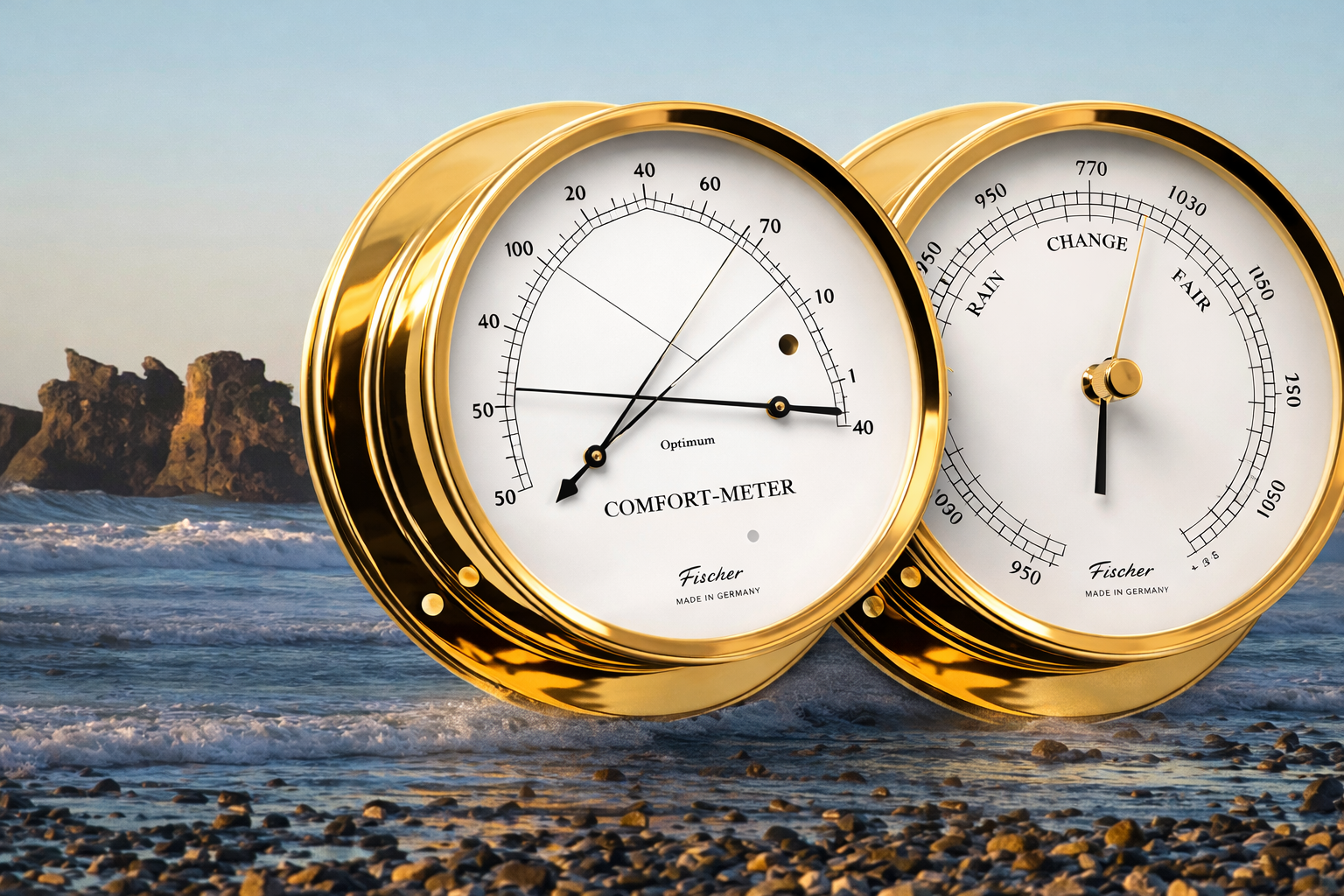
At Time & Trends, we have a range of traditional and precision barometers designed to make atmospheric pressure easy to observe at home.
Whether you're interested in weather, simply appreciate the craftsmanship of a quality barometer, or want to keep an eye on atmospheric pressure alongside your own symptom diary, a barometer can be a fascinating addition to the home.
Explore our range of barometers and discover what the atmosphere is doing around you.



Leave a comment (all fields required)